Interactive 3D · Skateboarding history · Free
Hubba Hideout
An iconic spot, preserved.
Hubba Hideout is an interactive 3D tribute to one of skateboarding's most legendary spots, built by Tyler Edic. The real Hubba Hideout in San Francisco was demolished in 2011. This reconstruction lets you walk the camera around it again, and step into the exact angle of eight famous photographs taken there.
Free · Runs in your browser · No download, no account

About the project
What is the Hubba Hideout 3D project?
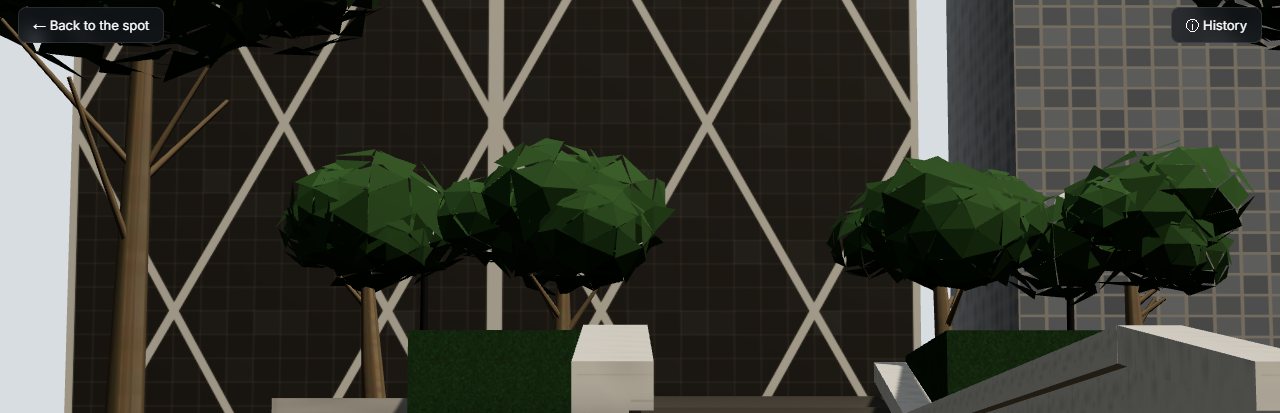
It is a 3D memorial you can explore in a browser. The stairs, the ledges, the brick plaza and the surrounding buildings of Hubba Hideout have been rebuilt as a model, and you can orbit the camera freely around the spot as it stood.
Along the bottom of the screen is a timeline of eight tricks landed there between 1991 and 2010. Pick one, and the camera flies to where the original photographer was standing. The real photograph then appears, lined up one-to-one over the 3D model, so you see the trick exactly where it happened.
Hubba Hideout is a companion to NBD Finder, Tyler's skate spot map, where the spot is listed as a piece of skateboarding history.
How it works
How to explore Hubba Hideout
- Open it. Go to hubba.nbdfinder.com in your browser. A short history of the spot opens first.
- Look around. Drag to orbit the camera around the stairs and ledges and see the spot from any side.
- Pick a trick. Choose one of the eight tricks in the bar along the bottom. They are in order by year.
- Step into the photo. The camera flies to the photographer's position and the original photo appears over the model.
- Go back. Hit “Back to the spot” to return to the free camera, or “History” to reread the story.
What's in it
Features
- A faithful reconstruction. The stairs, both ledges, the plaza and the buildings behind are modelled from real-world measurements.
- Free-orbit camera. Move around the spot and study it from angles no photo ever showed.
- Photo-matched tricks. Each trick has a camera position matched by hand to the original photograph.
- A timeline, 1991 to 2010. Eight tricks in order, from Wade Speyer's crooked grind to Peter Ramondetta's 50-50.
- The history. A short written history of the spot, its name and its demolition.
- Photographer credits. Every photo is credited to the photographer who shot it.
The spot
What was Hubba Hideout?
Hubba Hideout was a world-famous street skateboarding spot near Embarcadero Plaza in San Francisco, California. It was part of a concrete pedestrian footbridge built during a mid-1950s urban renewal program: two oversized sets of six stairs, flanked on both sides by large, plain cast-concrete ledges, against a backdrop of downtown office buildings.
The nickname came from the place itself. Its secluded layout made it a discreet hangout for drug use, and “hubba” was Bay Area street slang for crack cocaine. Skateboarders started skating the ledges in the late 1980s and early 1990s, and the spot appeared in so many magazines and videos that “hubba” became the standard skateboarding word, worldwide, for any ledge that runs down alongside a set of stairs.
Over the years the city of San Francisco altered the site repeatedly to deter skating, adding dirt gaps and metal “skate stopper” brackets, before demolishing the walkway, stairs and ledges for good in January 2011.
The eight tricks in the timeline
| Year | Trick | Skater | Photo |
|---|---|---|---|
| 1991 | Crooked Grind | Wade Speyer | Bryce Kanights |
| 1994 | Frontside Bluntslide | Carl Shipman | Bryce Kanights (Thrasher cover) |
| 1995 | Switch 5-0 | Fred Gall | Gabe Morford (Thrasher cover) |
| 1996 | Waist-high 50-50 | Brian Anderson | Theo Hand |
| 1997 | Frontside Smith Grind | Lavar McBride | Independent Trucks ad |
| 1998 | Backside Noseblunt Slide | Eric Koston | Dave Swift |
| 1999 | Switch Backside Tailslide | Josh Kalis | Mike Blabac |
| 2010 | Backside 50-50, 180 Over Gap | Peter Ramondetta | Gabe Morford |
Each original photograph is credited to its photographer inside the experience.
Behind the product
How Hubba Hideout was made
Hubba Hideout was created by Tyler Edic as a companion to NBD Finder, using AI-assisted development. The spot was rebuilt from real-world measurements, so the proportions of the stairs and ledges match the place skaters remember.
The hard part was the photo matching. For each trick, the camera had to be placed where the photographer stood, pointed the same way, with the photo hung in the scene at the right size and tilt so its ledges and stairs line up with the model's. Tyler made a small tuning tool for the job and matched each photo by eye, one at a time.
The photos hang in the 3D world at the spot itself rather than being pasted to the screen, which is why the transition from model to photograph feels like the picture is materialising in place.
FAQ
Hubba Hideout: frequently asked questions
What is the Hubba Hideout 3D project?
It is an interactive 3D recreation of Hubba Hideout, the demolished San Francisco skate spot, built by Tyler Edic. You can orbit a model of the spot in your browser and pick from eight tricks landed there between 1991 and 2010; for each one, the camera flies to the original photographer's position and the real photo appears lined up over the model. It is free at hubba.nbdfinder.com.
What was Hubba Hideout?
Hubba Hideout was a world-famous street skateboarding spot near Embarcadero Plaza in San Francisco, California: two sets of six concrete stairs flanked by large concrete ledges, part of a pedestrian footbridge built in the mid-1950s. Skateboarders began skating it in the late 1980s and early 1990s.
Why is it called Hubba Hideout, and what is a hubba?
“Hubba” was Bay Area street slang for crack cocaine, and the spot's secluded layout made it a hideout for drug use, which gave it the nickname. Because the spot became so famous, skateboarders around the world now use “hubba” to mean any ledge that runs down alongside a set of stairs.
When was Hubba Hideout demolished?
The city of San Francisco demolished the walkway, stairs and ledges in January 2011, after years of modifications meant to deter skateboarding there.
Which tricks are featured?
Eight: Wade Speyer's crooked grind (1991), Carl Shipman's frontside bluntslide (1994), Fred Gall's switch 5-0 (1995), Brian Anderson's waist-high 50-50 (1996), Lavar McBride's frontside Smith grind (1997), Eric Koston's backside noseblunt slide (1998), Josh Kalis's switch backside tailslide (1999) and Peter Ramondetta's backside 50-50 with a 180 over the gap (2010).
Who made it?
It was built by Tyler Edic, a project manager who designs and ships his own products, based in Savannah, Georgia, as a companion to his skate spot map, NBD Finder.
Is it free?
Yes. It is free, runs in a web browser and needs no download or account.
See it for yourself
Rest in peace, Hubba Hideout.
The spot is gone, but you can still walk around it. It is free and runs in your browser.
Hubba Hideout is an unofficial, non-commercial tribute. The photographs shown in the experience belong to their photographers and publishers and are credited there; none of them are reproduced on this page.